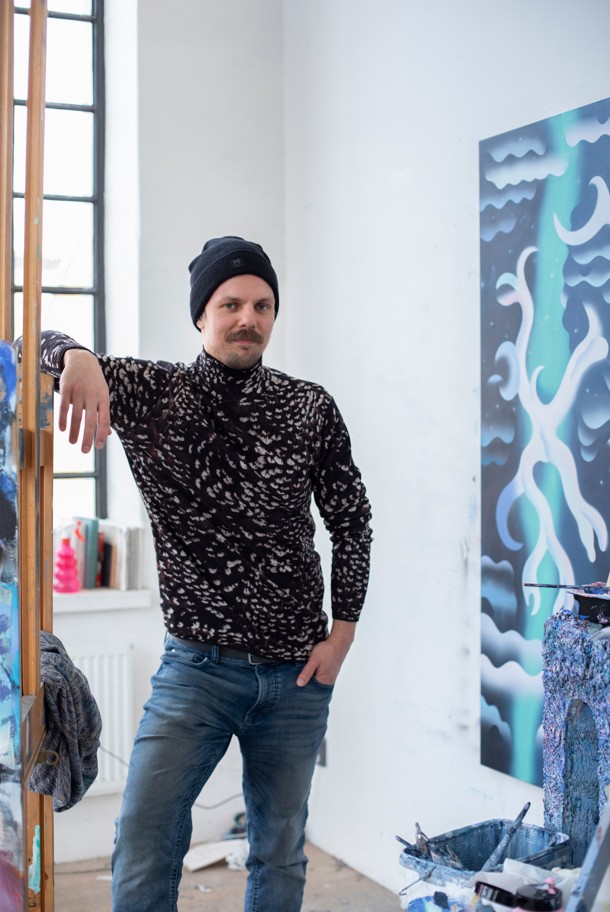
Jakub Tytykalo
The work of Jakub Tytykalo (1984) draws clear inspiration from classical modernism. Fragmented beings, still lifes, landscapes, and more recently also urban scenes are reminiscent of Cubism through their compositional structure and reduced color pale...


Morning Magic, 170 x 140 cm, acrylic on canvas, 2025

Ephemeral Encounter, 200 x 260, acrylic and spray on canvas, 2024

Untitled, 2025

The Metamorphorer, 130 x 170 cm, acrylic on canvas, 2025

Metamorphosis, 170 x 140 cm, acrylic and spray on canvas, 2025

Sunbathing, 120 x 170 cm, acrylic on canvas, 2024
Testimonials
All testimonials
Already during your studies at AVU, you become familiar with what the careers of other figures from the art world look like. Gradually, you discover your own opportunism as a certain driving force that cannot be simply suppressed. You begin to ask questions about where and in what light you will exhibit, who will represent you, and who will follow your work. The art world in which you exist should ideally be clear and transparent, at least as far as the values at stake within it are concerned. The art world has varying degrees of resolution. Some institutions can make an artist appear larger, while others will shrink them or let them disappear into the noise. Over time, you begin to notice that individual exhibition opportunities are not just neutral places where you place your work. And sometimes you also discover that opportunism does not necessarily have to be something to be ashamed of. That is perhaps the strange paradox of an artistic career: you try to create something meant to be independent of the system, and at the same time, you spend your whole life learning how to exist within that system. And yet, through all of this, there is one more—perhaps the most important—factor: the human element. Behind all the institutions, galleries, names, and their varying degrees of resolution are specific people who decide whose trust to earn, who to approach, and with whom they want to collaborate. In our case, this is primarily Anna Pulkertová and Marek Jakúbek, whose approach represents for us precisely that rare combination of professionalism, trust, and personal interest. At such a moment, the initial question of where and in what light one presents oneself begins to change slightly. It is no longer just about the value a given place holds in the hierarchy of the art world, but also about the people you meet there and what you are able to offer one another.
unconductive trash
Rudi Koval and Michal Pěchouček, art duo

Anna Kyjovská

Improving employee mental well-being is one of the main goals companies emphasize when designing new offices. And according to research, the installation of art can be one of the elements that significantly contributes to this goal.
Martin Židek
Head of Architecture, CAPEXUS
01
02
03