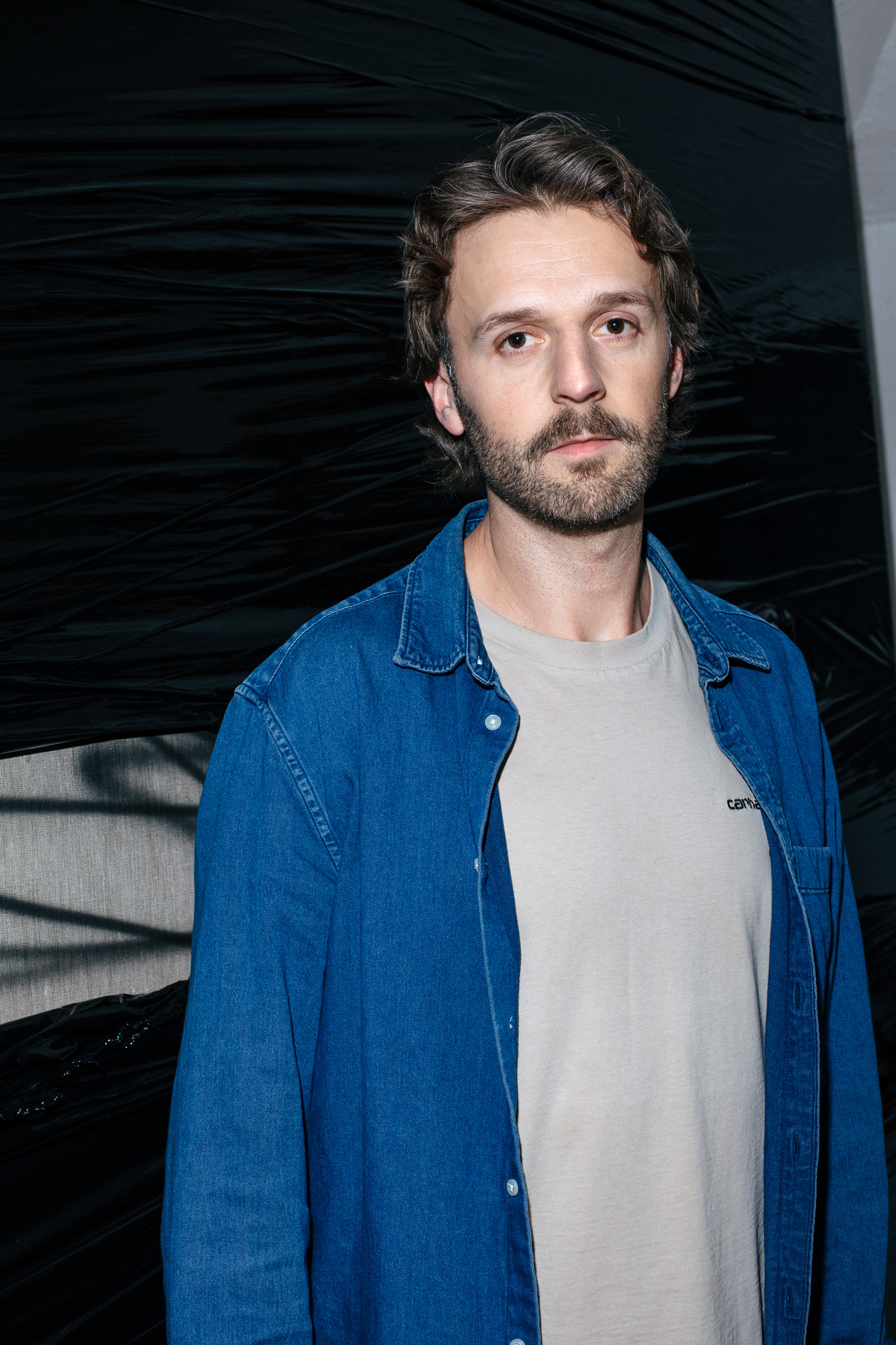
Milan Vagač
Milan Vagač (1987, Bratislava) is a Slovak visual artist living in Prague. In recent years, his work has focused on the intersection of painting, object, and spatial installation, which he explores within the context of the physical image influenced...


Gizmo_060324, 50x70 cm, acrylic on canvas, 2024

Gizmo_180324, 50 x 70 cm, acrylic on canvas, 2024

Gizmo_181222, 80 x 110, acrylic on transparent fabric, 2022

Gizmo_300323, 130 x 180, acrylic on transparent fabric, 2023

Gizmo_080123, 80 x 110, acrylic on transparent fabric, 2023

Gizmo_080224, 160 x 140, acrylic on transparent fabric, 2024
Testimonials
All testimonials
Already during your studies at AVU, you become familiar with what the careers of other figures from the art world look like. Gradually, you discover your own opportunism as a certain driving force that cannot be simply suppressed. You begin to ask questions about where and in what light you will exhibit, who will represent you, and who will follow your work. The art world in which you exist should ideally be clear and transparent, at least as far as the values at stake within it are concerned. The art world has varying degrees of resolution. Some institutions can make an artist appear larger, while others will shrink them or let them disappear into the noise. Over time, you begin to notice that individual exhibition opportunities are not just neutral places where you place your work. And sometimes you also discover that opportunism does not necessarily have to be something to be ashamed of. That is perhaps the strange paradox of an artistic career: you try to create something meant to be independent of the system, and at the same time, you spend your whole life learning how to exist within that system. And yet, through all of this, there is one more—perhaps the most important—factor: the human element. Behind all the institutions, galleries, names, and their varying degrees of resolution are specific people who decide whose trust to earn, who to approach, and with whom they want to collaborate. In our case, this is primarily Anna Pulkertová and Marek Jakúbek, whose approach represents for us precisely that rare combination of professionalism, trust, and personal interest. At such a moment, the initial question of where and in what light one presents oneself begins to change slightly. It is no longer just about the value a given place holds in the hierarchy of the art world, but also about the people you meet there and what you are able to offer one another.
unconductive trash
Rudi Koval and Michal Pěchouček, art duo

I consider my cooperation with Artist's Hero on the pop-up exhibition for Veolia Energie to be a very positive initiative and experience. Placing paintings in offices opens up space to encounter art even for those who might not actively seek it out otherwise. I think that is a fantastic idea. I can feel the enthusiasm for the cause from Marek Jakúbek and Bára Alex Kašparová; the collaboration was not only very professional, but also friendly and open. I enjoyed browsing through the gallery of other artists. From an artist's perspective, they deserve a big thank you for this!
Katarína Szanyi
visual artist, painter

I consider the collaboration with Artist's Hero on the pop-up exhibition for Veolia Energie to be a very positive experience. The visit of Marek Jakúbek and Bára Alex Kašparová to my studio was incredibly pleasant, energetic, enriching, and inspiring. Communication went very smoothly and everything we agreed upon worked out perfectly.
Markéta Hermanová
visual artist, painter
01
02
03