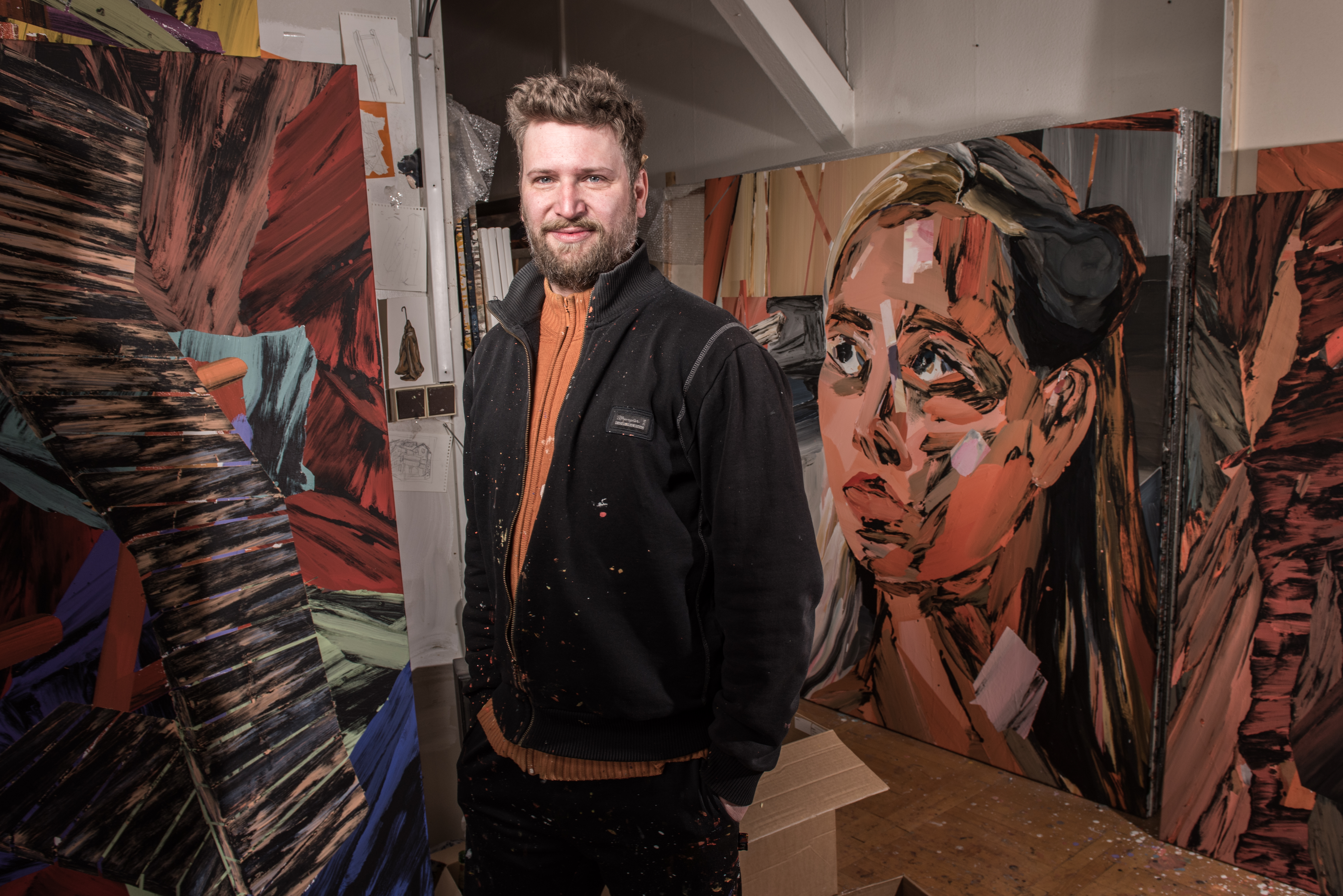
Samuel Paučo is one of the most prominent painters of his generation, with a clearly recognizable signature style. His predominantly large-format canvases, created in thematic cycles, naturally transcend the boundary between concrete subjects and abs...


M 16, mixed media on canvas, 175 x 210 cm, 2023

F 71., mixed media on canvas, 200 x 200 cm, 2017

F 115., mixed media on canvas, 175 x 210 cm, 2020

F 147., mixed media on canvas, 205x 250cm, 2021

M 20., mixed media on canvas, 34 x 30 x 30 cm, 2023

F 106, mixed media, 175 x 220 cm, 2020

F 38., mixed media on canvas, 200 x 250 cm, 2017

M 5., mixed media on canvas, 205 x 250 cm, 2023
Testimonials
All testimonials
It was a pleasure to take part in the pop-up exhibition at the Veolia premises in Ostrava (3-12/2025). The collaboration with Artist’s Hero and its founder Marek Jakůbek was highly professional in every aspect – from transport and installation to the presentation of the exhibition. I would like to thank Marek for the friendly dialogue and Bára Alex Kašparová for the curation. I wish Artist’s Hero the best of luck with their future projects!
Jan Pražan
visual artist, painter

Improving employee mental well-being is one of the main goals companies emphasize when designing new offices. And according to research, the installation of art can be one of the elements that significantly contributes to this goal.
Martin Židek
Head of Architecture, CAPEXUS

The work of Artist's Hero is carried out in a highly professional spirit – from the initial invitation to the exhibition project and its organization, all the way to the return of the artworks to the studio, everything was perfect. I am also very grateful for the company of artists that I could be a part of during the *Beyond Space* exhibition at Capexus, as well as for the curatorial selection of my works by the wonderful Anna Pulkert. Marek is a person with an amazing vision and a beautiful approach to life. I wish him and Artist's Hero many successful projects in the future as well.
Karolína Rossí
visual artist, painter
Testimonials
All testimonialsIt was a pleasure to take part in the pop-up exhibition at the Veolia premises in Ostrava (3-12/2025). The collaboration with Artist’s Hero and its founder Marek Jakůbek was highly professional in every aspect – from transport and installation to the presentation of the exhibition. I would like to thank Marek for the friendly dialogue and Bára Alex Kašparová for the curation. I wish Artist’s Hero the best of luck with their future projects!
Jan Pražan
visual artist, painter
Improving employee mental well-being is one of the main goals companies emphasize when designing new offices. And according to research, the installation of art can be one of the elements that significantly contributes to this goal.
Martin Židek
Head of Architecture, CAPEXUS
The work of Artist's Hero is carried out in a highly professional spirit – from the initial invitation to the exhibition project and its organization, all the way to the return of the artworks to the studio, everything was perfect. I am also very grateful for the company of artists that I could be a part of during the *Beyond Space* exhibition at Capexus, as well as for the curatorial selection of my works by the wonderful Anna Pulkert. Marek is a person with an amazing vision and a beautiful approach to life. I wish him and Artist's Hero many successful projects in the future as well.
Karolína Rossí
visual artist, painter