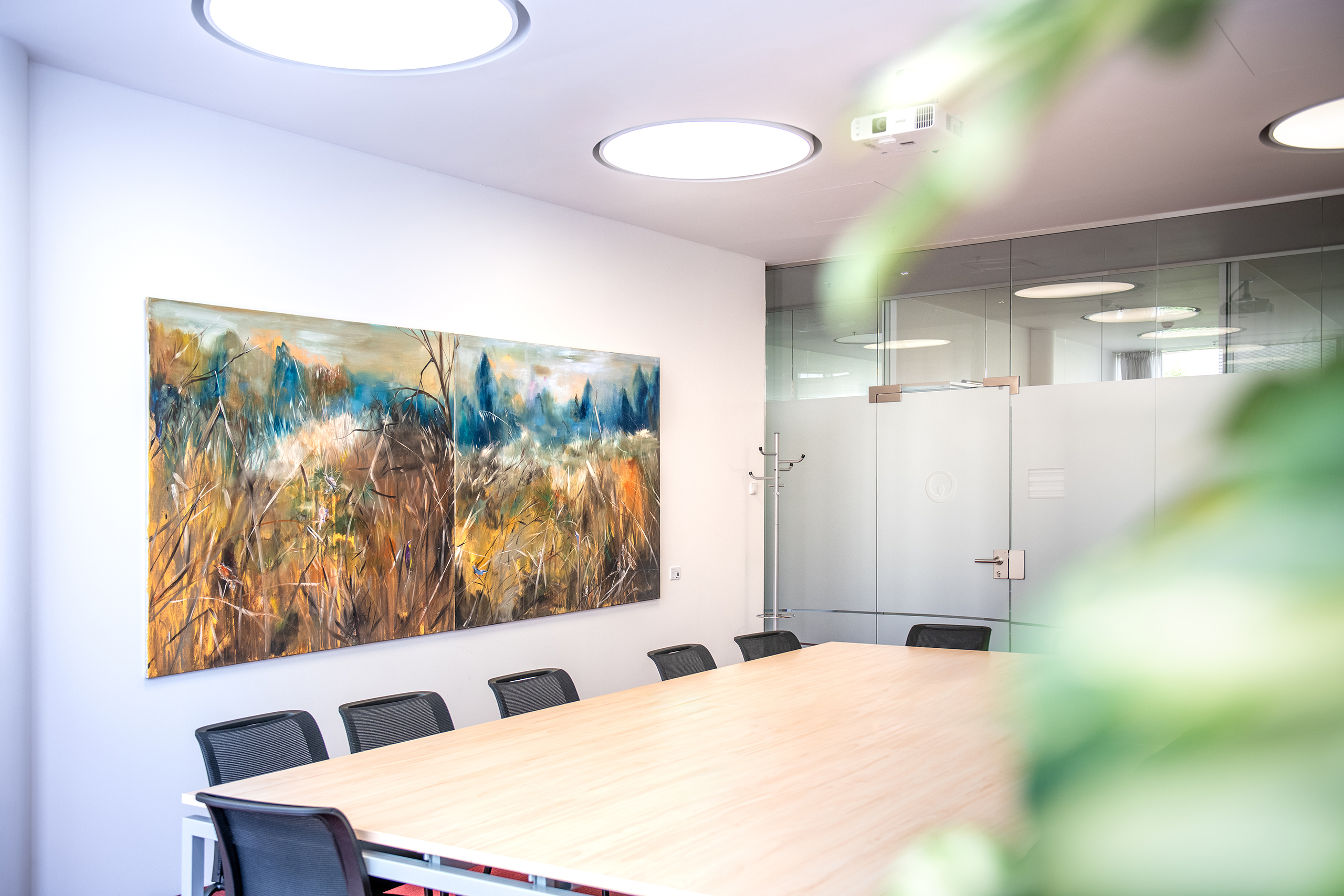
Artworks displayed in the common areas of the offices are not merely an aesthetic enrichment of the modern work environment, but represent Veolia’s deeper commitment to employee care, the development of (corporate) culture, and social responsibility. Through the Artist's Hero platform, Veolia brings contemporary art closer to our colleagues with the aim of creating a work environment that inspires with new themes and perspectives on the world, cultivates aesthetic sensibilities, and elevates mental well-being. By supporting young artists through the rental of their works, Veolia simultaneously helps them reach a wider audience, communicate their perspective on important topics, and financially support the domestic art scene. You can find out more about the initiative on the Veolia Energie website.
Veolia places a strong emphasis on caring for both people and the planet. As a leader in the ecological transition, we not only strive to minimize our environmental impact, but also to inspire a responsible approach across all our operations—including employee care and a positive social impact in the realm of culture.
Curated by Bára Alex Kašparová, the exhibition presents works by artists who explore the relationships between nature and humanity, as well as issues of biodiversity, ecology, and environmental protection. These works subtly convey that nature is truly seen by Veolia, communicating our commitment to ecological and social responsibility alongside our vision of a future where human activity is in harmony with nature.
We are proud to create a space for dialogue between the delicate world of art and the professional world of the energy business, because we believe in mutual inspiration. We also believe that the green energy we strive for every day alongside our more than 2,400 employees at Veolia Energie is, in its own way, an art form in itself.
We believe that our attention is an increasingly valuable currency, and we wish to dedicate it to quality content that stimulates both the mind and the soul while bringing deeper meaning. We thank the exhibiting artists and our colleagues for their openness to this art initiative and for our shared inspiration on the path toward the art of ecological transition.
The exhibition will be on view at the Veolia Energie ČR offices in Ostrava from March 5 to the end of December 2025, and the artworks can be admired in various common areas, including hallways, kitchenettes, and meeting rooms.
Curator's Statement by Bára Alex Kašparová
Climate change, soil erosion, loss of biodiversity, the overuse of water resources, deforestation, and landscape pollution. These are just a few of the major issues concerning the contemporary landscape that surrounds us. The artist has always been perceived as someone more sensitive to everything happening around them, someone capable of communicating even the often unseen, and someone gifted with the ability to convey such messages through a universally understandable language. This is no different for the male and female artists presented here as messengers who bring testimony about the contemporary landscape—critically, yet with fascination and poetic quality. Through a universal visual language, all four artists open up pressing social themes, pointing not only to a dystopian form and the fear of the near future, but also presenting the beauty of wild nature, which often remains hidden from many eyes—not least because being physically present in it can be very demanding and uncomfortable.
All four artists represent distinct creative approaches, ranging from the spiritual to mystical landscape painting of Jan Pražan, to the color-modified and painterly refined landscapes presented by Markéta Hermanová. Patrik Kriššák offers a fresh perspective on the landscape using his own signature technique, while Katarína Szanyi captures nature not only through specific plant fragments, but also through its subtle nuances of light.
These works introduce not only the diversity of approaches among a young generation of academic creators, but above all the quality of their work, designed to offer an opportunity to experience this aspect through living alongside them, thereby establishing a benchmark against which the personal taste of every art lover can be refined.
Contemporary art takes many forms, and this representative selection primarily showcases artists who are authentically connected to a relationship with the landscape, contemporary ecological issues, and Ostrava itself. The fascinating purity and sophisticated rationality allow the forms of the artworks to stand out—not only to cultivate the everyday environment, but also to showcase the qualities of domestic artists whose works resonate in numerous exhibition halls, and now right among you.
Patrik Kriššák
Patrik Kriššák (born 1986 in Kežmarok, SK) studied painting in the studio of Daniel Balabán at the Faculty of Art in Ostrava. His work freely oscillates between figuration and often gestural abstraction. A specific feature of his aesthetic approach is striking color, linearity, and a signature style defined by a developed technique in which he applies paint directly from containers onto a canvas placed in a horizontal position, without using a paintbrush. This specific form serves as a support surface for emphasizing current socio-scientific themes, such as ecology, nature conservation, and environmental behavior, as well as information technology, which influences human thinking and actions. An intuitive, automatic approach corrected by rational intent creates a balance between ambiguity and the directness of the author's statement. The artist generally works in broader series of paintings. His latest series, *Extinction*, focuses on global climate change, which is already beginning to impact natural ecosystems. The paintings depict corals and underwater landscapes that suffer the most from these changes and are slowly approaching extinction.
His long-standing prominent position on the contemporary art scene is evidenced by numerous nominations for prestigious awards, such as the STRABAG Art Award (2011), Start Point Prize (2011), Critics' Award for Young Painting (2012), Painting of the Year – VÚB Award (2019), and his participation in the Zlín Youth Salon (2015).
Markéta Hermanová
Markéta Hermanová (born 1985 in Opava) is a graduate of the Faculty of Art at the University of Ostrava, where she studied in the Painting II studio led by František Kowolowski. In 2008, she created her *Necropolis* cycle, which dealt with Ostrava’s scenery. However, her intention was not to create a *veduta* of a specific place, but rather a painterly and semantic shift. Within her chosen trajectory of meaning, the city views suddenly became explicit bearers of the artist's critical message. She therefore often chose locations destined for imminent destruction (the Jindřich hotel building) or future dramatic transformation (the Karolína coking plant).
In her recent work, she predominantly focuses on landscapes marked by human intervention—whether through abandoned, half-ruined architecture or the disruption of landscape structures by mining. Hermanová transforms these interventions into a painterly language, creating her own modifications of the obvious and the seen, contrasted with the unseen and artistically created. She approaches the motif of mountains and high mountains in a specific way: across technically precise canvases, she works with changes in scale, poetization, and semantic shifts to emphasize the main goal of her efforts—drawing attention to human interference in the original character of the landscape while simultaneously presenting a healed landscape that, despite these crude, destructive interventions, can transform into something poetically fascinating.
Katarína Szanyi
Katarína Szanyi (born 1974 in Košice) has Hungarian and Slovak roots, but her name is closely tied to Ostrava, where she works not only as a painter but also as an educator. After studying at the Secondary School of Applied Arts in Košice, she moved on to study Intermedia Interventions in Architecture before transferring to the painting studio at the Department of Fine Arts of the University of Ostrava under the guidance of Daniel Balabán.
Katarína Szanyi's work has a dual nature. It radiates calm, silence, and fragile melancholy while simultaneously bursting with energy. Her work focuses on the relationship between surface and depth, often through landscape fragments and light effects. She works with polarities such as the part and the whole, the concrete and the abstract, which she does not separate, viewing them instead as essential aspects of complexity. Her paintings are organic wholes formed by an amorphous-poetic mold of matter and a color-light atmosphere.
Working with light plays an important role in her work as a unifying element. In her creative journey, she has bridged the moment of achieving an internally cohesive pictorial unity. Her artistic work has gradually evolved from a more narrative painterly approach to working with the fragmentation of motifs and more complexly layered repetitions. Purity of expression, subtle nuances within the specific represented motif, and airy compositions are hallmarks of her current work. A nearly transparent water surface suddenly reveals both plant elements and the reflection of sunlight. By exploring the possibilities of blurred boundaries between the concrete and the abstract, she successfully expresses the unique relationship between depth and surface, drawing the viewer into a fragile moment of transience and generously allowing them to meditate for as long as they wish.
Jan Pražan
The creative output of Jan Pražan (born 1979 in Hradec Králové) stems primarily from the artist's unconscious, which he develops through long-term self-exploration and an understanding of the transpersonal aspect.
Pražan studied in the Painting II studio at the Faculty of Fine Arts of BUT in Brno under Mainer and Rathouský. His work is intrinsically tied to landscape painting, often of specific locations. Pražan captures not only the nature of the landscape environment and its atmosphere, but also imprints the subtle nuances of subjective emotional experiences and the essence of a place—qualities that are usually difficult for the eye to perceive precisely due to their subtlety, transience, and subjectivity. This collection of individual components of his creative expression forms an immersive realist-fantastic space that captures spiritual moments while uncovering the finest details.
Pražan's paintings bridge art with poetry, light, nature, the cosmos, and movement. In his work, he weaves together the idea of restoring relationships between humanity, the Earth, and the universe. He focuses primarily on the relationship with the landscape, which has been his main interest in recent years. He uses indigenous rituals to navigate his inner self and interpersonal relationships. He works with his subconscious, often through automatic painting. In his works, he also turns to his ancestors, who sometimes make appearances. The theme of relationships also extends into his non-artistic activities—as an artist and educator, he supports the development of marginalized children.