Art gives meaning to a place. It establishes a place through the distinctiveness of its communicated message, provided it is not merely a formal, empty, aestheticized object. It is a commitment to communication. That is the difference between a work of art and decoration. Both the artwork and the process of its creation must possess an intrinsic integrity that, in the context of its environment, creates a “place” that becomes a reference point within the cultural heritage of the city. Assoc. Prof. Ing. arch. Miroslav Cikán, architect and educator. (Manual for Artworks in Public Spaces of the Capital City of Prague, 2018).
Based on a study of the document ARTWORKS in the Public Spaces of the Capital City of Prague, we share key concepts, perspectives, and terms regarding the issue of visual art in the context of public space.
The Role of Art
An artwork placed in a public space fundamentally brings the same values as any work of art in general. It is worth recalling its necessity in the context of its potential roles:
Aesthetic role – the work enriches the aesthetic value and livability of the environment.
Place-making role – it completes a location, strengthens its identity, and increases its attractiveness and stimulation.
Promoting diversity – the variety of artistic expressions fosters the city's cultural richness and tolerance for the new.
Cultural role – it cultivates and enriches the cultural dimension of life for both society and the individual.
Social role – it mediates artistic experiences for the public and can bring the community together around a place.
Educational role – encountering art educates, cultivates, and encourages critical reflection.
Commemorative and mnemonic role – it reminds us of personalities, events, and values, preserving the memory of a place.
Representative and symbolic role – it expresses the idea of both the commissioner and the author while interpreting the significance of the place.
Economic and marketing role – it enhances the city's attractiveness and image, drawing in residents, tourists, and investors.
Historical Context of Art in Public Space
For a long time, Prague lacked a clear vision for art in public spaces: too few high-quality, site-specific works are created, while public spaces—especially in the center—become cluttered with low-quality works that have little connection to the character of the place. This degrades the overall quality of the public space and leaves Prague lagging behind other European capitals. Furthermore, the city long failed to act as an active creator of public space programming; art in public spaces was viewed conservatively, and after 1990, the continuity of its regular installation was disrupted.
As a result, the public was largely unexposed to contemporary developments for about a quarter of a century. High-quality works were created mainly thanks to individual artists and initiatives, and Prague today lacks significant works by domestic and foreign authors from the late 20th and early 21th centuries. This is primarily because cultural capital was long underestimated as a factor in urban development and competitiveness. There was a lack of conceptual strategy and systemic support for art in public spaces at both the state and municipal levels, funding for the creation and management of works from Prague's budget was insufficient, and coordination was lacking between the city, its institutions, the state, city districts, and private initiatives. Additionally, the process of creating artworks was frequently non-transparent, and public opinion in the 1990s and early 2000s was relatively conservative, which in turn influenced the stance of municipal authorities.
There was also a lack of active public education and promotion of contemporary art and its evolution. Commercial interests in exhibiting a work often took precedence over criteria of quality and its impact on the surroundings, and the post-1990 era saw the loss of systemic backing for public art through the abolition of the 4% funding mechanism (which had operated since 1968) and the institutions responsible for integrating art into architecture and public spaces as part of state construction contracts, without any new instrument taking its place.
Permanent Artworks in Public Space: Why They Have Different Rules Than Temporary Installations
An artwork that remains in one place for years is not the same as a temporary installation. It becomes a permanent part of its surroundings—and therefore must withstand higher and stricter demands: resisting weather and wear, making sense within the context of the specific site, and maintaining the validity of its concept even years down the line. Moreover, society commits to caring for it: repairing damages and performing ongoing maintenance to ensure it lasts as long as possible.
This is precisely why the realization of a permanent work in a public space should be preceded by an expert assessment of the proposal, a high-quality evaluation of the artwork itself, and a consensus among all stakeholders—typically achieved through a design competition.
Works of a permanent nature are placed in a space for the long term and form a lasting part of the environment and property. For this reason, unlike temporary installations, they must meet higher demands in terms of physical durability, the necessity of reflecting the site's context, and justifying the concept the artwork represents.
Four Basic Types of Permanent Art in Public Space
The methodology of the Manual for Artworks in Public Spaces of the Capital City of Prague distinguishes four main categories (this is not an exhaustive list, but rather represents the main types):
Sculptures, statues, and other 3D objects – whether figurative, non-figurative, or interactive pieces that also serve a functional purpose for visitors (seating, play, etc.).
Paintings, reliefs, and mosaics – meaning two-dimensional works on facades and surfaces.
Artistic elements of architecture, infrastructure, and urban design – benches, water features, fountains, lighting, and similar functional elements of public space treated artistically.
Multimedia and intermedial installations – works engaging with contemporary technologies.
Basic Principles for Achieving Quality in Public Art
The quality of an artwork intended for a public space must be assessed comprehensively, with respect to the location to which it belongs. It is determined by the sum of three equally important criteria:
the artistic quality of the work itself,
its qualitative content,
the spatial quality of its placement in relation to the surrounding public space.
Art in public spaces affects not only the quality of a given place but also cultivates the aesthetic taste and mindset of society. Therefore, the creation of high-quality, site-anchored works should be actively supported. What principles should be applied to maximize quality?
Transparent process – a high-quality work can only be created through a thoughtful, transparent procedure involving both the commissioner and independent experts.
Conceptual approach – this should determine priority locations, themes, and types of investments, developed in cooperation with independent experts and institutions, ideally under the management of a (municipal) curator.
Diversity of forms – the space should accommodate traditional, conceptual, and experimental art alike.
Quality over quantity – public space is currently oversaturated, so it is better to have fewer high-quality works than many weak ones; expensive and flamboyant does not automatically mean high quality.
The "minimum risk art" trap – a formal, bureaucratic, and timid approach results in non-controversial yet empty works that offend no one but offer nothing either; poor-quality art tends to degrade a space, which is why insisting on expert quality assessment is essential.
Best Practice: Realization of Art Through an Architectural and Artistic Design Competition
A proven and transparent method for selecting both the artwork and the artist is a design competition. For major investments in public space, a competition should always take precedence over other selection methods for the following reasons:
it rules out speculation regarding clientelism and bias—it is a standard, transparent procedure used for acquiring permanent works in advanced foreign cities as well,
it addresses the surrounding area alongside the artwork itself, allowing the piece to be integrated into the site rather than added later in a problematic manner,
it provides the commissioner with multiple specific designs tailored to the specific location, from which the highest-quality and most suitable option can be chosen,
it improves the city's media image, and for prominent locations, an international competition can attract foreign artists and elevate Prague's cultural prestige abroad,
thanks to an expert and legally regulated jury, it guarantees an impartial, transparent, and high-quality decision—furthermore, the jury serves as a guarantor of the brief and helps defend the result before the public,
it allows key stakeholders to be involved as early as the preparation of the brief, thus preventing later disputes during implementation,
it creates a fair competitive environment that attracts artists and architects with equal access while yielding original solutions,
it provides opportunities for yet-uncovered local artists and recent art school graduates who lack secured commissions.
Process Diagram for the Realization of an Artistic-Architectural Design Competition
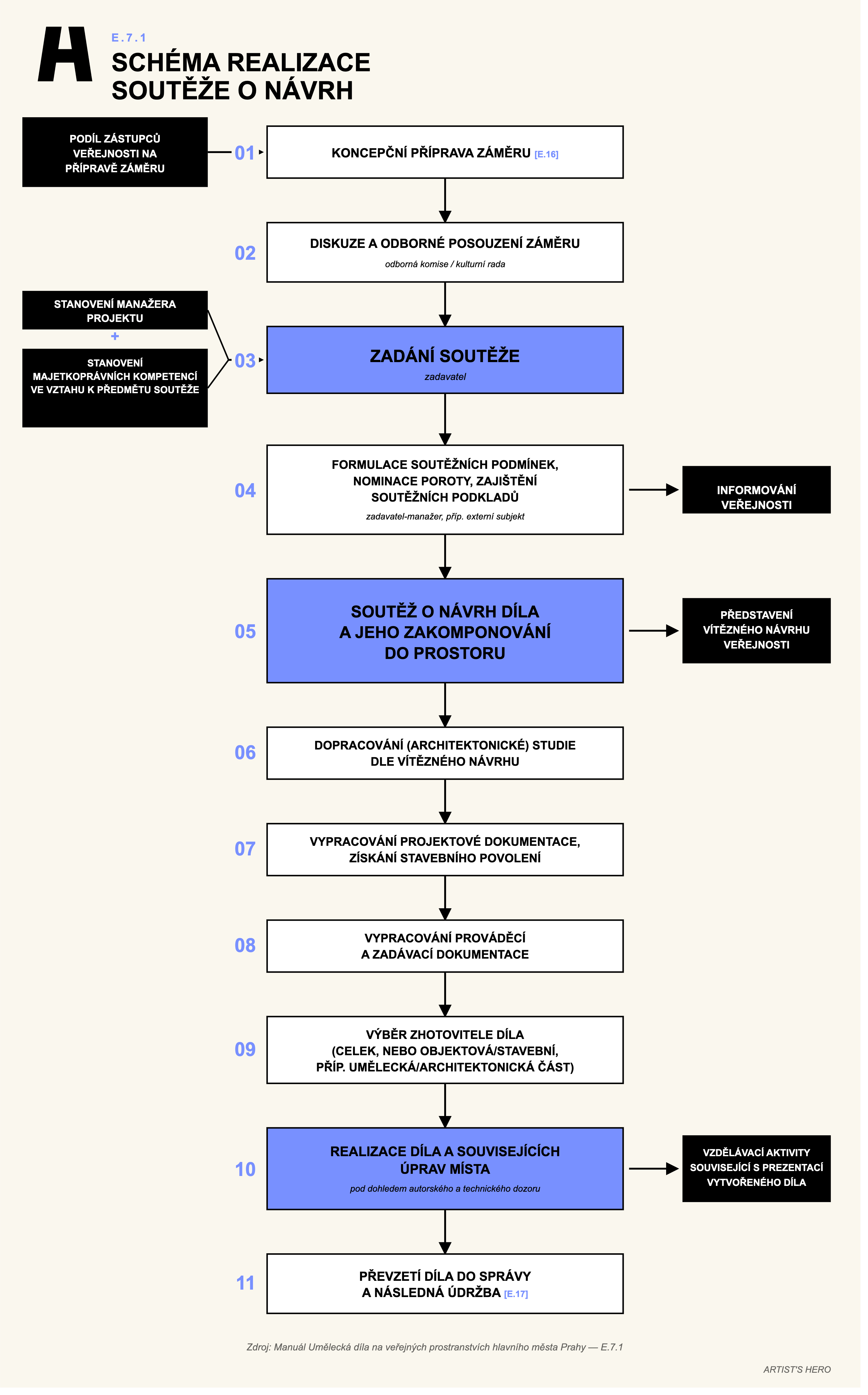
Artist's Hero: Project Manager and Their Role
The realization of a permanent artwork in a public space should be managed as a socially responsible project: with clearly formulated goals, established formal requirements, and coordination of all participants entering the process at various stages. For larger investments, it is crucial to designate a project manager at the outset—a specific institution or responsible team that guarantees the acquisition of the artwork. Without clearly assigned responsibility, there is a risk that the project will fall apart along the way, deviate from its original intent, or fail to reach its intended form.
The project manager guides the project from the formulation of the concept through to completion, representing the investor and acting on their behalf. They are responsible for setting up, fulfilling, and achieving the project's results, and their main task is to maintain the integrity of the original concept and ensure communication among all participants so that responsibilities do not become fragmented.
Their core activities include:
Coordinating the professions involved in preparing the artwork, preparing tender procedures and contractual relationships,
Communicating among stakeholders and representing the commissioner to the artist and other parties involved,
Monitoring deadlines, quality, and compliance of the realization with the original concept, the commissioner's requirements, and valid legislation and standards,
Securing post-realization guarantees and service, including maintenance conditions for the artwork,
Final inspection and handover of the work.
Artist Testimonial: MgA. Tomáš Skála
I appreciate the mission of Artist's Hero primarily because it provides a level of service in a space that has previously lacked any such formatting between artists and clients within our local environment. It is precisely in this domain that misunderstandings, unrealistic expectations, or disappointments can arise between two different worlds that often lack experience in collaborating with one another. Having had the opportunity to get to know Marek Jakúbek personally, I realized that he is experienced both in the processes and environment of artistic practice and in the world of business, development, and corporate structures. This makes him a fully-fledged mediator for projects connected to the realization of artworks in public spaces or within development projects.
I personally went through a similar experience in the past, when I won a commission to create a sculpture for a water feature in a public space. The competition targeted young artists primarily, and the fee for realization was low. Out of a lack of experience, I chose the path of experimentation to fit within the budget. A year and a half later, the sculpture began to erode, and I had to remove the installation prematurely. The municipality had no way to release additional funds to repair the work, and I lacked the capacity to remake the sculpture at my own expense. The result was an economic loss, a damaged reputation, and shattered trust. It was a major career fuck-up for me, and I have been careful ever since to avoid similar situations.
I believe my case is not an isolated one, and investing in collaboration with Artist's Hero can significantly minimize such risks. If you have a mediator on your project who is capable of asking both sides the right questions, translating mutual requirements into an understandable language, utilizing and sharing their experience, taking over the administrative side of the realization, and preparing presentation materials, you have an investment that will ultimately pay off. It ensures the quality of the artwork, a smoother realization process, time savings, and ultimately can even affect the final financial costs of acquiring the piece.
For me, as an artist, it is a high priority that the realization goes smoothly and that I have a good feeling about the entire process. This means minimizing stress around administration and communication and having the opportunity to focus maximally on the realization itself for the best possible, lasting, and high-quality result of the creative process.